Chain Actuator Maintenance Checklist: Window, Hinges, Cable and Safe Isolation
Direct answer
A practical chain actuator maintenance checklist starts with the manufacturer’s own operating and maintenance information, then covers safe isolation, the window and brackets, hinge and seal condition, cable and controller checks, a careful functional run, and a short written record—without assuming a single universal service interval.
Read the actual schedule
Before you set any calendar reminder, read the schedule and cautions that came with your actuator and control set. Guidance such as Ventilation: Approved Document F points owners and installers to operating and maintenance information for ventilation systems, so treat that documentation as the primary source rather than a generic “annual” habit if the manual differs.
Where your kit is a chain-style electric opener supplied with a controller and remote, keep the variant paperwork with the unit so you can match checks to that configuration.
Safe isolation
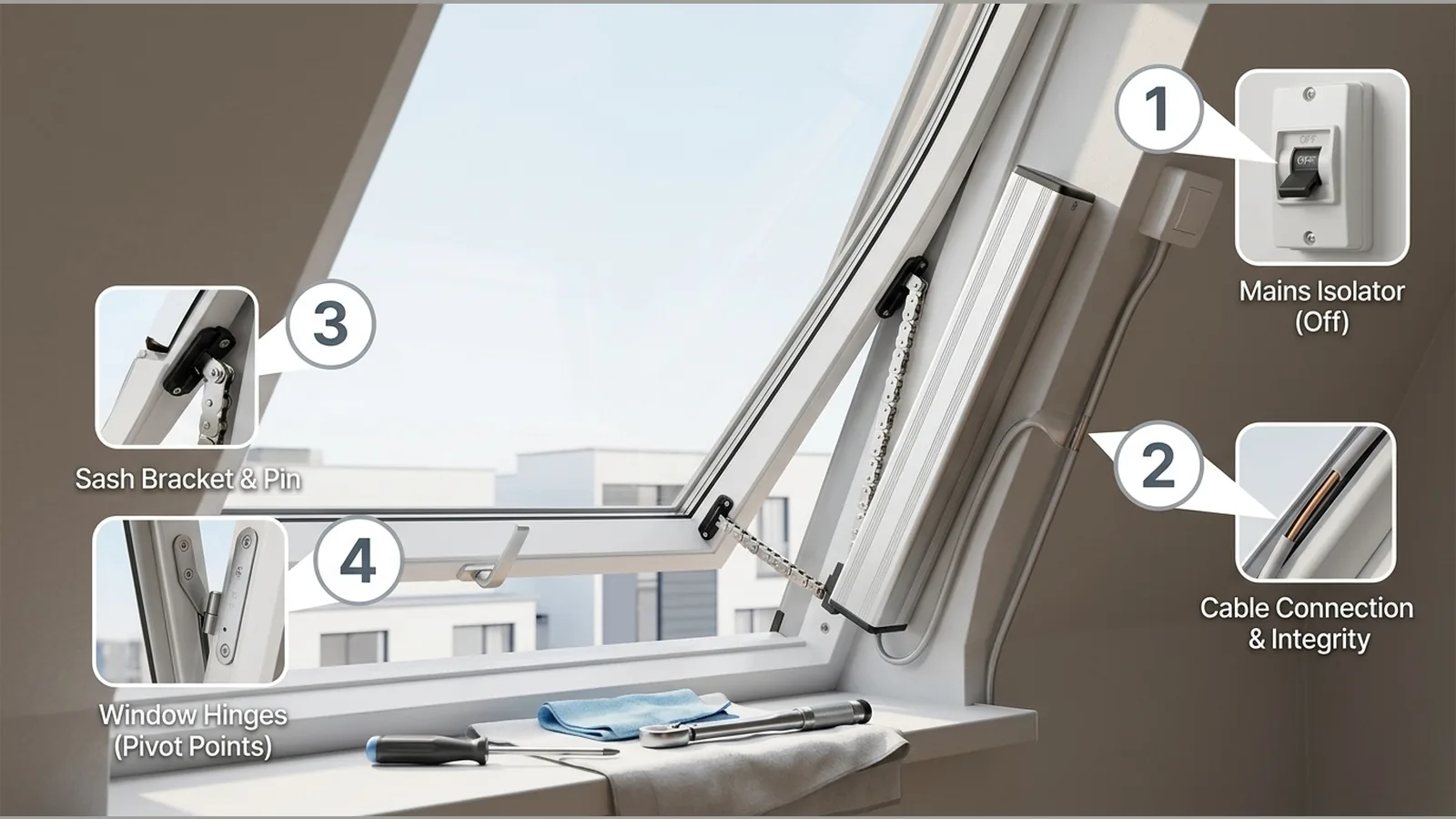
Disconnect power before any service work on the actuator or associated wiring. Installation instructions for comparable window actuators state that power must be disconnected during service, and chain-actuator manuals repeat the same safe-isolation expectation.
Isolation and any work at height need competent handling. If you are unsure how to make the circuit safe, stop and use a qualified installer.
Check window and brackets
Confirm the window remains suitable for powered operation and that mounting brackets and fixings are secure and free from obvious distortion or corrosion. Actuator instructions recommend checking window suitability as part of service-minded care.
- Look for loose screws, elongated holes or movement at the bracket.
- Confirm the sash can open and close freely by hand within its designed range before restoring power.
- For bottom-hung or similarly critical arrangements, respect the safety considerations in the chain-actuator manual rather than improvising restraints.
Hinge and seal inspection
Inspect the window hinges and perimeter seals, not the actuator chain for lubrication. Manufacturer guidance on hinge lubrication refers to the window hinges where recommended; do not assume the chain itself needs oiling.
- Check hinges for stiffness, play or missing lubricant where the window maker allows it.
- Check seals for tears, compression set or debris that could impede smooth travel.
- Note any binding that appears only under power—that is a cue to stop and investigate, not to force the sash.
Cable and controller checks
With power still isolated, inspect visible cable runs for pinching, abrasion or loose terminations at the actuator and controller. For kits that include a switch controller and remote, confirm the controller is firmly mounted and that any wall switch or handset is intact and labelled clearly for household users.
Do not alter wiring or substitute plugs or voltages outside what your documentation allows.
Functional test and record
Only after isolation checks and mechanical inspection are complete, restore power and run one controlled open–close cycle while standing clear of the sash path. Watch and listen for hesitation, unusual noise or incomplete travel, then return the window to a safe closed or ventilated position as your site requires.
Record the date, what you checked, and any faults. That record helps the next person follow the same chain actuator maintenance checklist without guessing what was last done.
When to call an installer
Call a competent installer if the window structure is doubtful, brackets have moved, cables are damaged, isolation is unclear, or the sash binds under power. Chain-actuator guidance also highlights window-condition and bottom-hung safety considerations that are not DIY improvisations.
Only a 12-month warranty duration is confirmed for the product discussed here; service intervals and warranty exclusions are not stated in the available facts, so do not rely on warranty wording you cannot verify in writing.
Soft product next step
If you are reviewing a chain-style electric opener with controller and remote for a skylight or high-level sash, see the current automatic skylight opener kit details and keep this checklist beside the manufacturer instructions for ongoing care.
FAQ
Is there one annual interval for every chain window opener?
No. Use the operating and maintenance information for your system. Approved Document F directs people to that information; it does not replace a product-specific schedule.
Should I lubricate the actuator chain?
No—distinguish window hinges from the chain. Where instructions mention lubrication, they address window hinge care and suitability checks, not routine oiling of the chain.
What belongs on an electric window opener maintenance pass?
Safe isolation, window and bracket condition, hinge and seal inspection, cable and controller checks, one careful functional cycle, and a written note of the outcome.
What about a window actuator annual check?
An annual diary reminder can help only if it matches your manual. If the documentation sets a different frequency—or calls for checks after unusual weather or works—follow that instead.