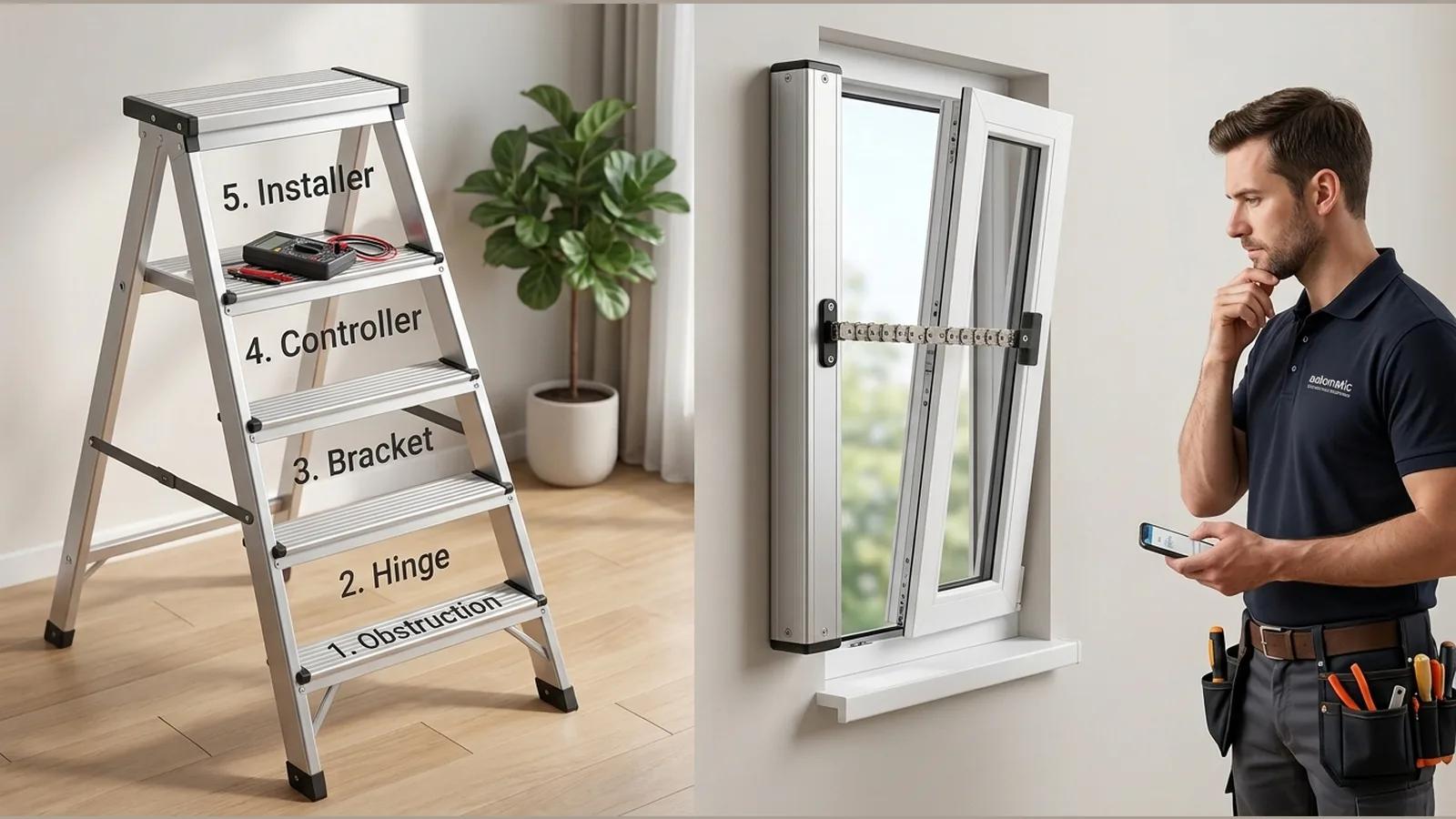
Chain Actuator Window Will Not Close Fully: A Safe Fault-Finding Order
Direct answer
If a chain actuator window will not close fully, treat it as a safety and fit issue first: stop the cycle, look for binding or damage, clear obstructions, then check brackets and seals before you question the controller or remote. Kits that include a controller and remote make it useful to separate a mechanical jam from a control fault, but use confirmed details calibration steps or force the chain.
Stop for binding or damage
Halt further open or close attempts as soon as you hear grinding, see the sash twist, or notice the chain kinked, bent or pulling against the frame. Continuing under load can worsen a closing fault and defeat the point of careful fault-finding. Manufacturer guidance for chain actuators stresses model-specific mounting and safety checks on a suitable window, so anything that looks bent, cracked or mis-mounted is a stop-and-inspect moment, not a reason to push harder.
Check obstruction and window condition
A common reason a window actuator leaves a gap is something simple in the closing path: debris on the sill, a catch that has not released, weatherstrip that has rolled out of place, or a sash that sticks in the frame. Look along the full seal line and hinges with the power isolated if you need a closer view. If the sash itself is warped, painted shut at the edges or clearly out of square, the actuator may be fighting the window rather than failing on its own.
Inspect bracket alignment and seals
With the system still and safe to approach, check that brackets sit flat, fasteners are present and the chain meets the sash without side-load. Misalignment often shows as an electric window not sealing on one corner while the opposite edge looks almost shut. Inspect gaskets for gaps, compression set or displacement. Installation instructions for chain actuators call for correct mounting and safety checks; if brackets have shifted or the window no longer suits the hardware, stop at visual findings and leave adjustment to a qualified installer.
Controller and calibration questions
When the sash moves freely by hand (where safe and designed to allow it) but a chain actuator closing fault remains under power, consider whether the controller or remote is still commanding a full close. Separate symptoms: no response at all, partial travel that always stops short, or a close that seems to complete then moves again. Some manufacturers publish troubleshooting for actuators that do not fully close or reopen after closing. Do not copy another brand’s calibration sequence, and do not assume error codes you have not confirmed for your exact kit.
Do not force chain
Never pull, lever or wind the chain by hand to close a remaining gap, and never bypass anti-entrapment or safety behaviour to “finish” a seal. Forcing the chain risks injury, frame damage and a worse jam. If the chain is already distorted, isolate power and get professional help rather than trying to straighten it in place.
When to isolate and call installer
Isolate supply before any work near wiring, terminals or inaccessible drives. Controller installation guidance typically requires qualified installation, safe isolation and accessible maintenance connections. Call an installer when you see structural damage, suspect electrical faults, cannot confirm safe isolation, or need mounting or sealing work beyond a visual check. Stop at observation and isolation; do not open live controllers or attempt structural fixes yourself.
Soft product next step
If you are reviewing kit contents for a like-for-like replacement path—actuator plus switch controller and remote—see the current automatic skylight opener kit details. Confirm suitability for your window with a qualified installer. Where stated for this offer, cover is a 12-month warranty; start dates, exclusions and returns carriage are not detailed here.
FAQ
Why does my window actuator leave a gap on one side only?
Often the sash, brackets or seals are uneven, so one edge meets first and the chain cannot pull the rest flat without strain. Check obstruction and alignment before blaming the motor.
Is a chain actuator closing fault always the actuator?
No. Kits with a controller and remote can show control or command issues as well as mechanical binding. Separate free sash movement from powered travel, then escalate electrical or mounting work to a qualified person.
What should I avoid if my electric window is not sealing?
Do not force the chain, defeat anti-entrapment features, or follow calibration steps written for a different product. Stick to visual checks, clear safe obstructions, isolate when needed, and call an installer for anything beyond that.